Prepared Classroom Foundation

Illustrative image

BASED ON TCCC MILITARY PROTOCOLS · FEDERALLY ALIGNED TRAINING

Schools have AEDs for cardiac emergencies. There's nothing on the wall for traumatic bleeding.

In a school emergency, law enforcement must clear the building before EMS can enter. That can take 20 to 30 minutes. Severe bleeding and chest wounds cause most preventable deaths in that window — and trained educators can start care in seconds with the right equipment. Prepared Classroom closes that gap.

TCCC PROTOCOLS501(C)(3) NONPROFITFEDERALLY ALIGNED TRAINING

THE SCHOOL TRAUMA RESPONSE TIMELINE

POTENTIAL EMS ACCESS DELAY

20–30

MIN

Time after a school emergency before law enforcement may clear the building for paramedics to enter.

Source: New York State Education Department, Standard Response Protocol Operational Guidance

FULL EDUCATOR TRAINING

2

HRS

Hands-on training in severe bleeding control and chest-wound care. No prior medical experience required.

UNCONTROLLED BLEEDING

35

%

A leading preventable cause of trauma deaths.

Source: 2024 American Heart Association First Aid Guidelines

TOURNIQUET APPLICATION TARGET

<60

SEC

Tourniquet application target: under 60 seconds.

Source: Tactical Combat Casualty Care — Tourniquet Application

During active shooter events, law enforcement protocols delay EMS entry. During that window, injured students and staff may receive no medical care. This is the gap a school trauma response program closes.

WHY SCHOOL TRAUMA RESPONSE SAVES LIVES

Most Preventable Deaths Come From Two Injuries

Military medicine identified them decades ago. Trauma surgeons documented the interventions. The data is clear. What's missing is the equipment — and someone trained to use it.

60%

Extremity Hemorrhage

Tourniquet application. Under 60 seconds.

The leading cause of preventable death in mass casualty events. Stopped with a tourniquet, applied correctly, in under 60 seconds. The same technique taught to every soldier in the U.S. military — and to millions of civilians through federally endorsed hemorrhage control programs.

33%

Chest Wounds

Vented chest seal over an open chest wound.

A vented chest seal is used for an open chest wound. It helps keep air from being sucked into the chest and can reduce the risk of a tension pneumothorax. It does not treat a tension pneumothorax once it has developed.

Data based on peer-reviewed mass casualty research and Tactical Combat Casualty Care trauma analysis.

THE PREPARED CLASSROOM SCHOOL TRAUMA RESPONSE PROGRAM

Three Parts. One System. Zero Medical Experience Required.

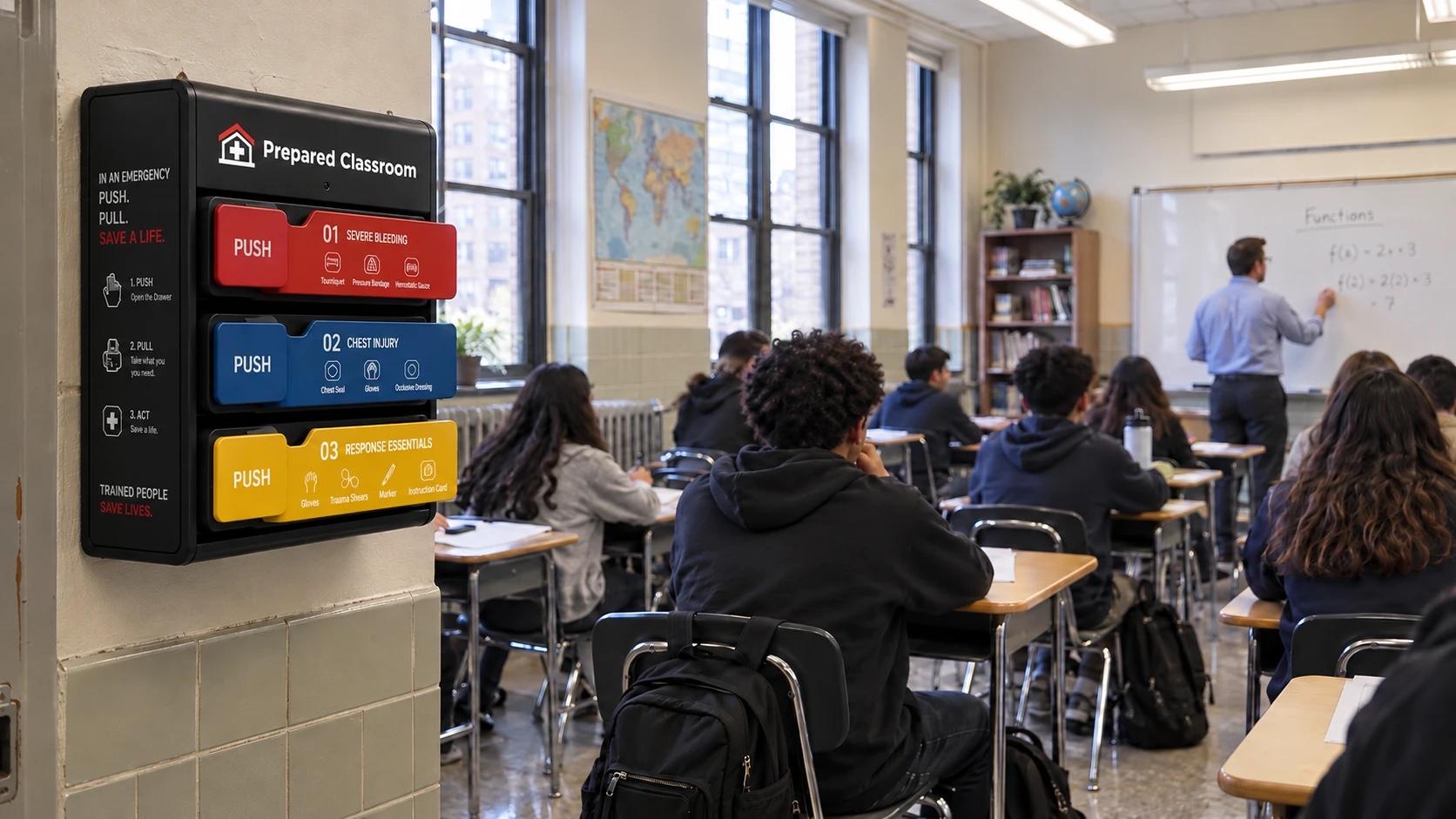
Prepared Classroom CARE Kit with three color-coded pull drawers: severe bleeding, chest injury and response essentials01

CARE Kits

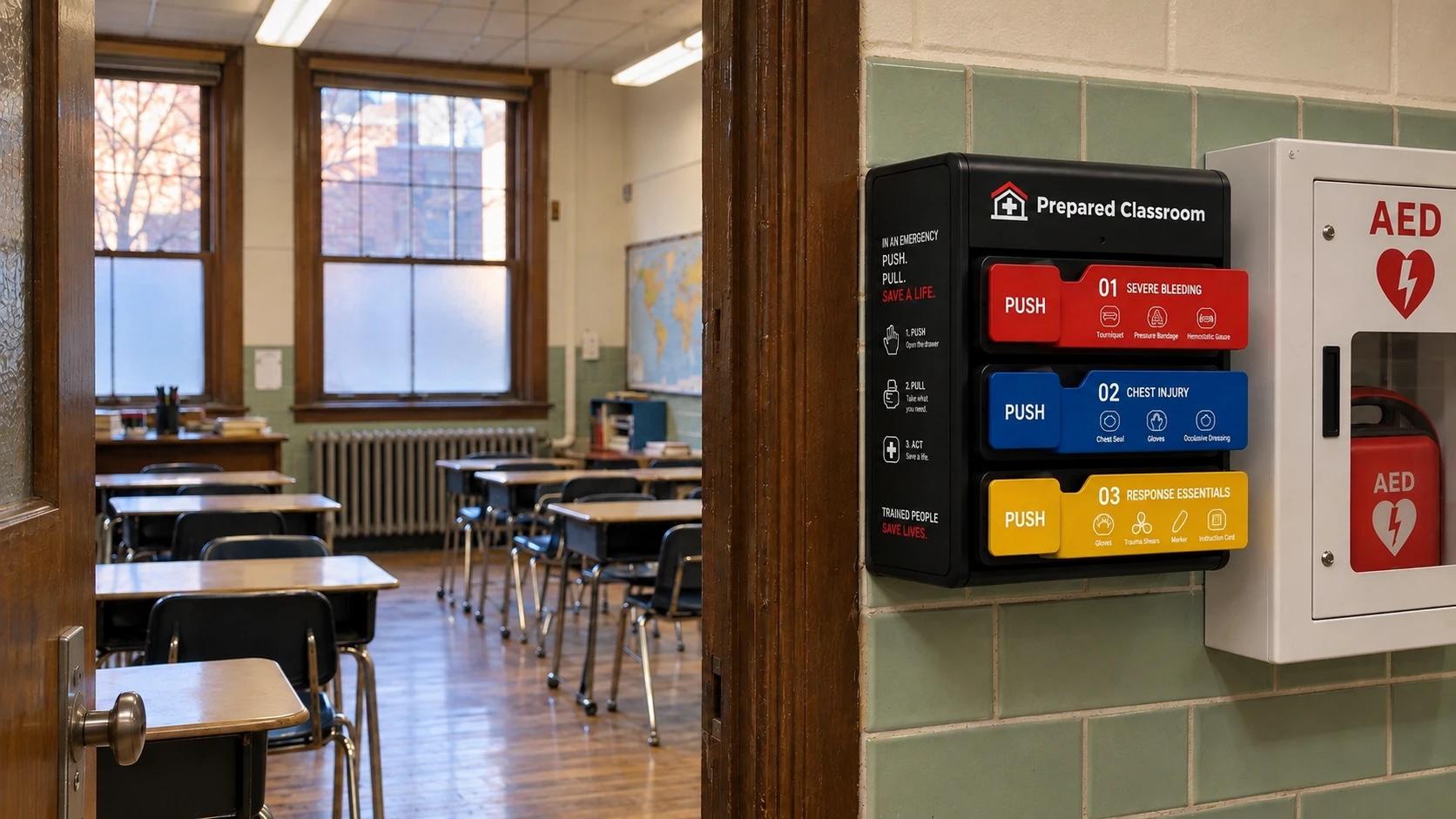
A CARE Kit mounts on the wall like an AED — visible, accessible, standardized. Inside: tourniquets, bleeding control dressings, chest seals, gloves, trauma shears, and instructions, organized into three color-coded drawers for non-medical responders.

See What's Inside →
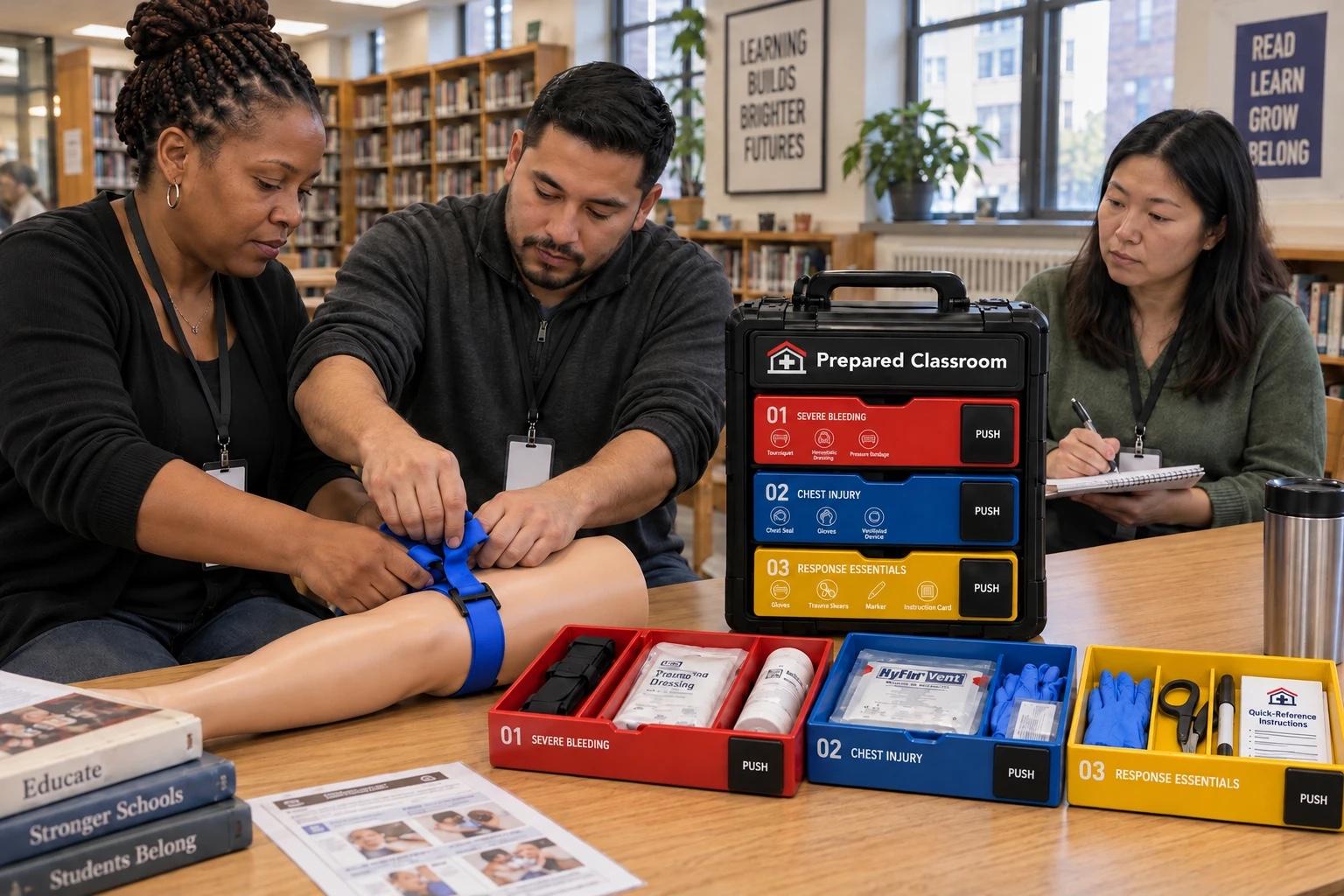
Educators practicing trauma response skills in a hands-on training session02

Educator Training

Prepared Classroom training is aligned with federally endorsed hemorrhage control protocols — the American College of Surgeons' Stop the Bleed program, which has trained more than 5 million people. The underlying science comes from TCCC. Tactical Combat Casualty Care is the framework behind a large reduction in preventable combat deaths, including more widespread tourniquet use by non-medics. A two-hour hands-on session covers every item in the kit.

See the Curriculum →
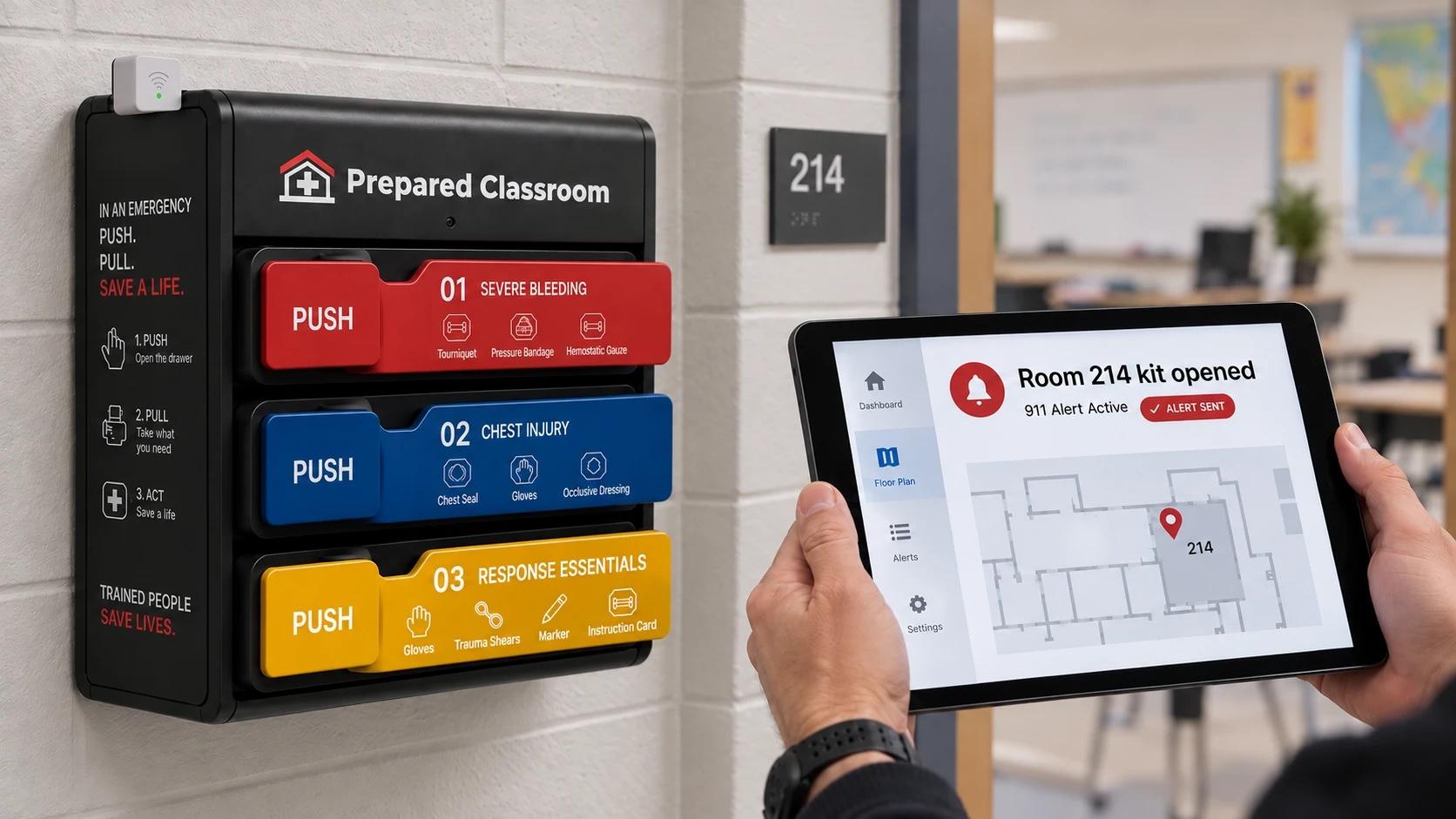
Opened CARE Kit sending a room-location alert to a tablet03

Smart EMS Integration

An IoT sensor in each CARE Kit automatically alerts emergency dispatch the moment a kit is accessed — with the exact classroom location. By the time law enforcement clears the building, EMS has a head start. That's not a feature. That's a system.

See the Technology →

Illustrative images

DESIGNED FOR SCHOOL DISTRICT IMPLEMENTATION

Built for Every School. Scalable to Any District.

Prepared Classroom is medical preparedness infrastructure. It belongs in public schools, private schools, faith-based institutions, and community colleges — any environment where students and educators are present and where EMS arrival cannot be guaranteed within minutes of an injury.

Classroom with a CARE Kit mounted on the wall
Illustrative image

Public School Districts

Scalable deployment across multiple buildings. District-wide training programs. Bulk kit pricing and grant funding coordination.

Private & Independent Schools

Turnkey implementation. No district approval required. Full support from site assessment through first training session.

Faith-Based Schools

Non-denominational, non-political medical preparedness. Medical readiness is a professional responsibility — not an ideological one.

Community Colleges

Extended campus environments, commuter populations, limited on-site emergency staff. CARE Kits and trained educators fill the gap where response time is unpredictable.

The Math Is Clear

3 to 5 minutes

How quickly life-threatening bleeding can become fatal.

20 to 30 minutes

Average emergency responder arrival time.

Up to 2 hours

The window a tourniquet safely buys for advanced medical care to arrive.

Having bleeding control kits directly inside classrooms closes the critical gap between injury and emergency arrival. Even in a rapid emergency response, traffic, campus size, and building access can delay paramedics from reaching a specific room in time. Immediate access to tourniquets, hemostatic gauze, and chest seals halts severe blood loss during those first decisive minutes before help can arrive. Stabilizing an injured person on-site preserves vital blood volume and significantly improves the chances of survival once hospital trauma teams take over. Equipping every classroom ensures that life-saving medical tools are already where they are needed most, turning a potential tragedy into a survivable emergency.

Source: STOP THE BLEED® (American College of Surgeons / U.S. Department of Defense)

EVIDENCE-BASED PROGRAM

Built on Protocols That Have Already Proven Themselves

Prepared Classroom does not ask you to trust a new idea. We ask you to trust the medical science that has already saved lives at scale and apply it to schools.

Federally Endorsed Training Standards

Our educator training aligns with the American College of Surgeons' Stop the Bleed program, which has trained more than 5 million people in the same skills we teach. Our program meets and exceeds those standards.

TCCC — Proven in the Field

The protocols behind CARE Kit training come from Tactical Combat Casualty Care (TCCC), the framework behind a large reduction in preventable combat deaths, including more widespread tourniquet use by non-medics. It was built for people who are not medics. That's exactly who we train.

Good Samaritan Protection

Good Samaritan laws in all 50 states offer important protection for people who render emergency care in good faith, though the details vary by state. We cover this in training and can help districts review their own policies.

501(c)(3) Nonprofit

Prepared Classroom is a registered 501(c)(3) nonprofit. Program costs are fully transparent. Donations are tax-deductible.

Every Classroom Can Be Prepared. Here's How to Start.

The implementation timeline from first contact to trained educators is measured in weeks, not months. Every school administrator will eventually answer the question of their emergency preparedness. The only question is whether they've answered it before they need to.

No commitment required. We'll walk you through equipment, training logistics, funding sources, and timeline.

Stay Informed. Help Make Schools Safer.